Android App Development in Chicago
From concept to publication. One dedicated expert, 12 years of experience.
iOS & Android12 years experienceBased in France
BOOK A CALL →

From concept to publication. One dedicated expert, 12 years of experience.
In short: android app development for Chicago (2,693,976 residents) means a project driven by a senior expert — not an agency. Direct communication, ownership of the code, published on App Store and Google Play within weeks.
For a clean initial project (MVP), expect between 2 and 4 months of work. Things must be done right for the Chicago market.
It is a mandatory document on the Google Play Store. It explains to users in the Illinois area what data you collect and why. I fill it out with you.
By optimizing the code. Poorly managed background tasks drain the battery, and the user deletes the app. We sit down and think about the architecture.
Yes, Google's API allows blocking usage if the user in Chicago has a version that is too old. Very useful for security.
The golden rule: explain the value, then ask. If we ask for camera access for no reason upon opening, the user in United States refuses.
It is when the app freezes. It is perceived as a bug. The key point is to optimize speed so the screen never locks up.
Yes, both languages can coexist. If you have an old app in Chicago, we can progressively upgrade it in Kotlin.
I integrate the design. If you do not have a UI/UX designer, I collaborate with experts who will create the screens for you.
I use physical devices (Samsung, Pixel, Xiaomi) and emulators covering a wide spectrum of screen sizes.
Contact me at the bottom of this page. We will schedule a call to ensure your idea makes technical sense.
Google Play hosts over 2 million apps (Statista, 2025).
How is yours going to stand out in Chicago?
It will not be with average design or constant bugs.
Users are ruthless.
A slow app means an immediate uninstall.
The key advantage of an expert developer is complete mastery of this chaotic environment.
Android means thousands of different screen sizes. Processors that vary wildly.
Building an Android app development project in Chicago requires extreme rigor.
You have to know Google's rules. Battery constraints. Ever-stricter permissions.
I handle all of that for you.
My goal is for your app to become obvious and essential for your customers in the Illinois area.
Not just another digital paperweight.
We set a real strategy. We build it cleanly. We launch it successfully.
People often ask me whether to start with iOS or Android for a project in Chicago.
The answer depends on your target audience and your budget.
The key advantage of Android is its massive reach.
Especially in emerging markets or for the general public.
But there is a fundamental difference with Apple.
Apple controls everything. They have about twenty iPhone models in circulation. It is easy to test.
Android is the wild west.
Google reports there are more than 24,000 active Android device models (Google, 2025).
Some have tiny screens. Others run on Android versions that are five years old.
This fragmentation makes testing much more complex and expensive.
You have to ensure the app does not crash on a cheap four-year-old phone, while still leveraging the power of the latest Samsung Galaxy.
However, Android is often the best choice to start if you are doing B2B in the Illinois area.
For example, equipping your delivery drivers or field technicians with inexpensive rugged tablets.
In that scenario, Android's open ecosystem is unbeatable.
You are launching your project in Chicago.
And you are probably wondering who to work with to build your mobile app.
It is the first major decision you have to make. Some people think that to succeed, you absolutely need a big agency right around the corner. Others believe they should outsource to the cheapest team they can find overseas.
Both options come with serious tradeoffs.
A big agency will assign your project to a junior developer you have never met. An offshore team will deliver code you cannot read, three weeks behind schedule, with zero accountability.
The most important factor in the success of an app is not just the code. It is communication.
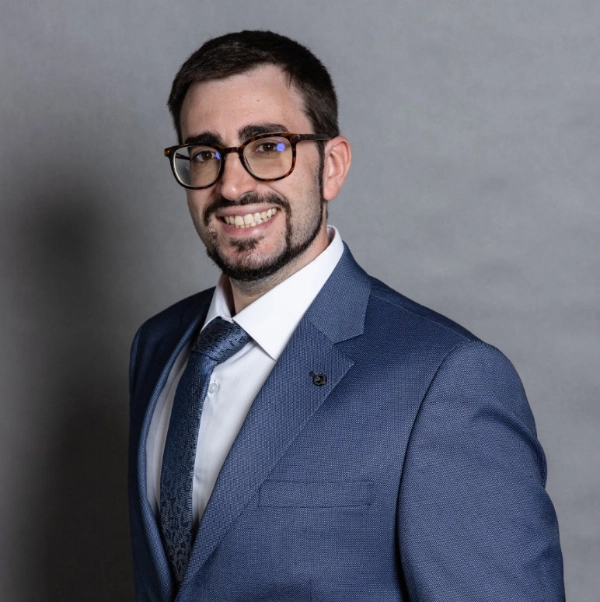
When you work with me, you get one dedicated expert with 12 years of experience and over 15 delivered projects. Not an account manager. Not a rotating team. One person who knows your project inside out.
Chicago work tends to come from established businesses rather than startups, which means there is usually a system already running and the app has to talk to it. The hard part is almost never the app. It is the API you already have, and how much of it we can use as it is rather than rebuilding it.
Most internal APIs were written for a web application on a fast office network, where an oversized response cost nothing. Put the same API behind a phone on a cellular connection in a basement and it takes eight seconds to answer, and the app looks broken while working exactly as designed. So the first real task on a Chicago project is usually measurement rather than design: see what the existing system actually returns, how fast, and decide what to fix on the server rather than paper over on the phone.
The second recurring question is what not to move. A mobile app that tries to reproduce a whole business system always fails — the screen is small, the user is standing up, and they have one free hand and thirty seconds. What works is three or four actions performed fifty times a day: log a job, confirm a delivery, look up a customer, photograph a document. Everything else stays on the desktop, and saying so plainly at the start saves the argument later.
Chicago's logistics and manufacturing base adds the field constraint on top: warehouses, yards and trucks, where signal is unreliable and the phone is not a desk. That pushes the same way every time — full offline capability with automatic sync, large touch targets, minimal typing, and no data loss if the device dies mid-entry. Those are architectural decisions made in week one, not features added in month four.
The work does not stop at publication. An app lives on systems that keep moving: iOS and Android each ship a major release every year, and an unmaintained app is eventually pulled from the stores. Invent Better plans for that in the original quote, rather than presenting it as a surprise six months after launch.
There is a very dangerous myth in the software industry. The belief that the work is completely finished the day your app goes live on the stores.
You push the launch button, the application becomes available in Chicago, everyone drinks champagne, and the development agency completely vanishes to work on their next client.
That is the absolute worst thing that can happen to your business.
A mobile application is not a painting that you hang on a wall and never touch again. It is a living, breathing organism.
Operating systems update constantly. Apple and Google change their strict security guidelines. Brand new devices with weird screen sizes hit the market every single month. And your users constantly change their habits.
You have a massive idea to disrupt your market in Chicago.
That is great. Now, we are going to shrink that idea by 80%.
Why?
Because 80% of app features are never used (Pendo, 2025).
In short, we are going to build a Minimum Viable Product (MVP).
We will focus on the single feature that truly brings value to the user in United States.
We build this V1 quickly.
Then, we send it to the 20 testers mandated by Google Play rules for new accounts.
Those 14 days of mandatory testing are not a constraint. They are an opportunity.
It is a chance to see how the app behaves in real conditions on the streets of Chicago.
To see where people click. Where they get stuck.
We adjust, we fix the silent bugs.
Then we publish.
Once on the market, your real users will dictate the next steps of the project.
If they scream for a new feature, we add it. Otherwise, we save your budget.
It is a question of financial and product logic.

Let's take a concrete example.
A client contacted me to build a home services booking app, specifically targeting the Illinois area.
The initial problem? The app had to target the general public.
And the general public uses Android. From all brands. At all price points.
The most important factor was managing Android's terrible fragmentation.
The app had to be as smooth on a five-year-old cheap Xiaomi as on the latest Samsung Galaxy S.
I rebuilt the interface using Jetpack Compose, Google's new design tool.
The result? Much lighter and more robust code.
We launched the app in Chicago via a Staged Rollout on the Google Play Console.
1% first. We detected a strange crash that only happened on old Oppo phones using Crashlytics.
We fixed it the exact same day. Without the majority of users ever noticing.
Then we opened the floodgates to 100%.
The app maintained a 4.8-star rating on the Play Store. And the client was able to expand their service without fearing their servers would melt.
Treat an Android budget as a growth line rather than an expense, because that is how it behaves. Someone online will code something for almost nothing, and it will be slow, insecure and impossible to extend. The useful comparison is not one quote against another, but the cost of building it twice against building it once.
When talking budget for an Android app in Chicago, you have to change your perspective.
It is not an expense. It is a growth tool.
You can find someone on the internet who will code you something for almost nothing.
Spoiler: it will be a technical disaster. Termites in a house.
The app will be slow on half of your United States customers' phones. Bugs will pile up. You will lose credibility.
In short, redoing a poorly coded app always costs more than doing it right the first time.
With me, you are not buying lines of code. You are buying a solution.
Certain industries have everything to gain by favoring a native Android strategy in Chicago.
I build mobile applications the way a craftsman builds a house. With solid foundations.
I've been doing this job for 12 years from Bordeaux, designing iOS and Android apps meant to last. I refuse sloppy work. The key advantage of this method? Your application won't collapse at the first Apple or Google update.
I create clean tools that are easy to maintain and ready to evolve alongside your SMB or startup. Work done with care is a profitable investment for the long run.
While you hesitate, your competitors in Chicago are moving forward.
The mobile world moves fast. Very fast. Today, 63% of global web traffic comes from mobile devices (Statista, 2025). If you keep pushing back the creation of your app, someone else will happily take your spot in Illinois.
But be careful, do not confuse speed with haste. Launching an unstable application is the worst possible strategy.
In short: you have to act fast, but above all, you have to do it right. ⏳
30 minutes to start
Book →Most of my projects run remotely, and in practice that changes very little. We talk over video whenever you need to, not only at major milestones, and you can reach me with questions at any point during the project — I always answer.
Once we are working together, travelling to meet you on site can absolutely be arranged if your project calls for it. Travel costs are quoted separately, upfront and with no surprises.